
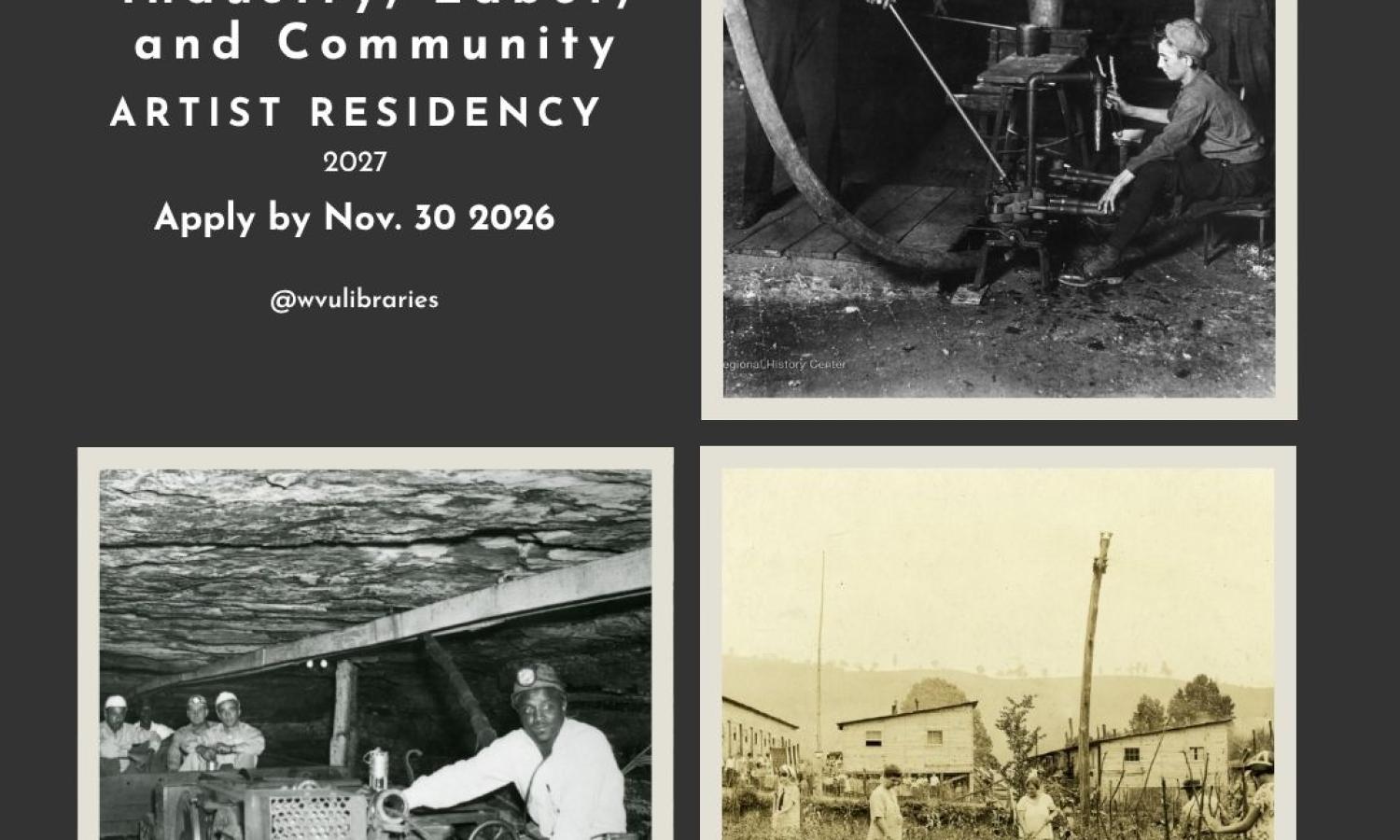
Industry, Labor, and Community AIR (Artist in Residency)
WVU Libraries’ Art in the Libraries Program invites applications for its 2027 Artist in Residence (AIR) Program, themed Common Threads: Industry, Labor & Community. Creatives across visual art, writing, dance, performance, book arts, digital media, and cultural heritage are invited to explore the West Virginia & Regional History Center (WVRHC) archives—including union records, company town history, oral histories, and community papers—to create projects that honor, reframe, and elevate West Virginia’s working-class heritage.
Residency Details & Support:
- Duration: 5 to 7 days in Morgantown, WV (March or April 2027), including at least 2 full days of archival research at the WVRHC.
- Funding: $1,000 honorarium, supply funding, plus travel, lodging, and per diem reimbursements.
- Public Engagement: Project display/exhibition at WVU Downtown Library and a 20-minute public presentation.
- Rights: Artist retains full ownership of created work.
Eligibility & Submission:
Open to U.S. and Canadian-based artists (18+). Preference given to WVU alumni and projects focusing on underrepresented narratives, local working-class history, or the human impact of regional industry.
Deadline: November 30, 2026
1549 University Ave
Morgantown, WV 26506
United States
Residency Program Information
Residency Program Summary
Application Information
The AIR program is open to all U.S. and Canadian-based artists and creators ages 18 and older. Preference is given to WVU alumni and applicants focusing on underrepresented narratives, local working-class history, or the human impact of regional industry.
Honoria ($1,000) paid upon residency and presentation completion.
Materials and supplies (up to $1,000) paid upon contract.
Travel, lodging and per diem expenses (up to $3,000) paid in reimbursement.
Accessibility
WVU Libraries facilities—including the Downtown Library, Evansdale Library, Health Sciences Library, and West Virginia & Regional History Center—are fully ADA compliant with accessible entrances, elevators, restrooms, and research spaces.
However, navigating between distinct areas of the Downtown Campus can present mobility challenges due to Morgantown's steep topography, historic brick pavers, exterior stairs, and incline gradients. While accessible building entrances and elevator routes exist for all main facilities, moving between buildings across campus often requires using designated accessible transit (such as the campus shuttle or PRT) or following specific paved detour routes rather than direct pedestrian paths
Housing & Accomodation
Studio & Facilities
We can discuss more studio space on a case by case basis.
We can discuss more studio space on a case by case basis.