

In this column, we offer reflections from ACA staff members—what we are reading, what we are thinking about, how we address the balance between our work lives and our creative lives (and the points at which those intersect). We asked Ellena Basada, who manages ACA’s communications, to share what she was thinking about.
I’ve been reading the first book of Pliny’s Natural History, written in the first century AD. It’s essentially the first encyclopedia; with thirty-seven volumes it covers everything the Ancient Romans knew about the natural world from agriculture and farming, to astronomy and cosmetics (ass’s milk to rid one of wrinkles!). Pliny is a very passionate and cogent writer. Apparently he read upwards of two thousand books in his lifetime—he read constantly, while walking, and bathing. And if he had to put a book down to rest his eyes, he would have someone read aloud to him. That’s inspirational. What to do with all this knowledge but to compile it in thousands of pages!
Despite Natural History being very knowledge-forward, which is to say fact-forward, Pliny has a flair for the superstitious—even mythical. Earthquakes can be foretold by foul-smelling waters and war; but “the occurrence we call rainbows have nothing miraculous or portentous about them, for they do not reliably portend even rain or fine weather.” Some of Pliny’s observations are radically contemporary and lucid: could we not add anything else to the nature of the rainbow now? Pliny’s thinking also holds a crucial role as the midway between modern thought and Ancient cosmologies.
One thousand years before Pliny attempted to catalog the natural world through observation and classification, the seasons were explained through myth. In the Homeric Hymn to Demeter, the turning of the year depends on the fate of Persephone. When Persephone is taken to the underworld by Hades, her mother—Demeter, goddess of the harvest—withdraws her gifts from the earth in grief. Crops fail, the soil hardens, and winter spreads across the land. Only when Persephone is allowed to return from the underworld does Demeter’s joy restore fertility to the fields, and the world blooms again. Demeter is depicted as a fragile old woman on the side of a dusty path, sitting beneath an olive tree. This is our Mother Earth.
Pliny continues this Ancient tradition of understanding the earth as a mother figure. “She receives us at birth, and gives us nurture after birth… She embraces us in her bosom and at that very time gives us her maternal shelter.” Pliny goes on to account for all the gifts humanity is given from the earth, which we abuse: “We probe her entrails, digging into her veins of gold and silver and mines of copper and lead; we actually drive shafts down into the depths to search for hems and tiny stones; we drag out her entrails, we seek jewelry merely to be worn upon a finger!”
And how far have we taken this two thousand years later?
In the first volume, at least, Pliny does not dwell on the nature of humankind itself, though he suggests that our impulse to know and understand the world is almost divine. But I wonder whether the impulse to extract, exploit, and possess arises from the same desire.
The image of the earth as a mother raises an uncomfortable question: what responsibilities do children hold toward their mothers? Early in life, the relationship is almost entirely one-directional. The mother gives; the child receives. Perhaps there is an assumption that someday the roles will reverse—that care will be returned.
But do we really want an earth grieving for everything it has lost? In a constant state of deferral, waiting for what we might give back to her?
For me, responsibility begins with noticing how much we take—and learning how to give back. It isn't necessarily in the what, but the how. The exchange between mother and child is rarely material; what is offered is attention, presence, love. Perhaps responsibility to the earth begins in the same place: tuning in, paying attention, breaking free from purely economic ways of thinking. Even the smallest gestures—from peeling an orange to talking with our neighbors—can become acts of return, and are part of larger, Ancient cycles of exchange.
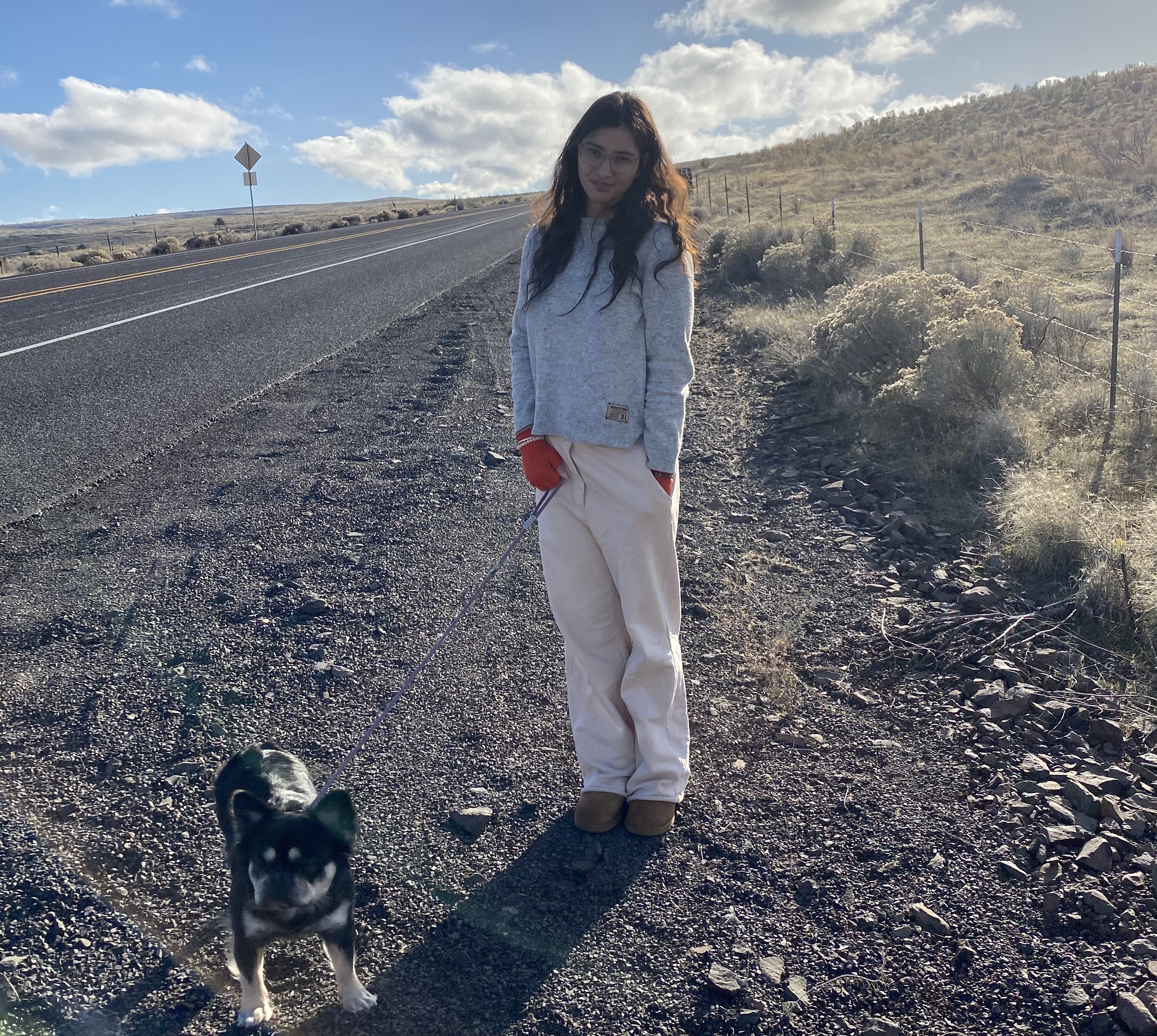
Ellena Basada is a writer + editor from Oregon, based in Brooklyn. A 2019 Fulbright Scholar in Berlin, her work has supported a range of nonprofit arts organizations, including the Oregon Institute for Creative Research, Portland Institute for Contemporary Art, Vermont Studio Center, and Hopscotch Reading Room. In addition to editing books for Fonograf Editions, she is an MFA candidate in Nonfiction at NYU, where she is an Axinn Fellow. Ellena writes criticism for publications such as BOMB and Adi Magazine. She practices yoga. |
We’d love to hear from you. Send your questions or reflections to ebasada@artistcommunities.org for a chance to be featured in an upcoming issue of our newsletter, Waypoints.