

As part of ACA’s ongoing reflection on our history and evolution over the past decades, we remain guided and inspired by the leaders who have shaped this field. In this column, we speak with members and colleagues whose perspectives illuminate the past, present, and future of artist communities. For this issue, we talk with Alana Hernandez, Senior Curator at the ASU Art Museum, whose work is dedicated to expanding access, centering Latinx artists, and reimagining what institutional support can look like.
ACA: You're the Senior Curator at the ASU Art Museum, an institution embedded within a large public research university. Where have you found real alignment between that context—its academic calendar, administrative structures, and public-facing expectations—and your curatorial approach? And where have you had to work against the grain?
ALANA HERNANDEZ: What I find genuinely aligned between a university art museum and my curatorial approach is the emphasis on research, experimentation, and dialogue. I tend to think of exhibitions not just as presentations, but as sites of inquiry and part of an art historical record. Being embedded in a research university, where knowledge production and critical exchange are already core values, feels like a natural fit. The academic calendar can also be generative, through teaching, student engagement, or programming that evolves over a semester. I’m also drawn to the public-facing aspect of that context.
At the same time, I’ve definitely had to work against the grain in certain respects. Administrative and beurcratic structures can slow things down or create layers of approval that don’t always align with the timelines artists need or the responsiveness I aim for in my practice. Indeed, the complex nature of language as it relates to administrations and funding can be rather complex.
I’ve also found that while the academic context encourages criticality, it can sometimes privilege certain kinds of discourse or audiences. Part of my work has been to push beyond that—thinking about how exhibitions and programs can remain porous, welcoming, and accountable to communities outside the university, not just those already fluent in its language.
So I see it less as a binary of alignment versus resistance, and more as an ongoing negotiation—leveraging the strengths of the university context while also creating space for other ways of working and engaging.
ACA: Can you talk about navigating a project with multiple constituencies? How do you think about responsibility not just in terms of care, but in terms of who is accountable for what, and to whom?
AH: An important part of my practice is thinking about curatorial work as inherently collaborative—exhibition-making isn’t a single-authored project, but something that can and should be multivocal. When I’m working on a project with multiple constituencies—artists, institutions, audiences, and sometimes community partners—I try to approach it as a process of active listening and translation between different priorities and forms of expertise. I also think accountability flows in multiple directions. I’m accountable to the artists in terms of representing their work with integrity, to the institution in terms of delivering a viable and thoughtful project, and to audiences in terms of accessibility and clarity. When community partners are involved, that accountability extends to ensuring that participation is not extractive but reciprocal and respectful. So, for me, navigating multiple constituencies is really about balancing openness with structure—creating space for multiple voices while also taking responsibility for how those voices come together in a shared project.
ACA: There is a lot of focus on policy as something that exists on paper to protect artists and staff. But policy on paper and policy in practice can look very different. How do you think about the ongoing work of actually enacting it, beyond the moments where it's formally invoked?
AH: I see policy as both a protection and a way of making an institution’s values legible and visible. But it only really matters if it’s lived in practice, not just invoked in moments of conflict.
One of the risks of policy is that it can feel fixed or untouchable, when in reality it should be iterative. So I think a lot about how policies are made: ensuring they include the perspectives of those most affected and that they're revisited over time.
In terms of enactment, it comes down to everyday behaviors and accountability. That means building shared understanding across staff, modeling the policy in decision-making, and creating space for people to raise questions or concerns before something escalates. Ideally, policy isn’t just a document you turn to in a crisis, but something that shapes the culture of how people work together. The work is ongoing.
ACA: Many of the artists you work with are navigating complex cultural, political, and geographic contexts. What does meaningful institutional support look like for them right now—particularly across borders or within underrepresented histories?
AH: For me, meaningful institutional support starts with recognizing that artists working across complex cultural, political, and geographic contexts are often carrying forms of risk. That’s something I’ve seen consistently in my work with Latinx artists, particularly those navigating transnational identities, migration, and other pressing issues.
Practically, that means support has to go beyond presentation. It includes flexible timelines, visa and travel advocacy, and fair compensation structures that reflect the realities of working in this country today and beyond its borders. It also means being careful about how work is contextualized—ensuring that interpretation doesn’t flatten or instrumentalize the cultural and historical specificity of the work.
In my practice, I also think a lot about language and access—how bilingual or multilingual frameworks can be built into exhibitions so that audiences aren’t excluded, and so that artists’ intentions aren’t filtered through a single dominant perspective.
Just as importantly, support means recognizing artists as knowledge holders. Especially in the context of Latinx art, where histories are often fragmented or underrepresented, it’s critical that artists have agency over how their work is framed and discussed.
And finally, I think about continuity: building relationships that extend beyond a single exhibition and being mindful of how visibility in a U.S. institutional context can have different implications elsewhere. Meaningful support is about resourcing the work materially, respecting it intellectually, and sustaining it relationally, with a particular attentiveness to the transnational and underrepresented contexts many Latinx artists are working within.
ACA: Your current retrospective of Carmen Lomas Garza looks incredible—can you tell us more about it, and what it means to bring her work to ASU right now?
AH: Yes, so I’m super pleased to be working with an elder artist to reaffirm that Chicanx histories are part of the history of this country. We can’t tell full nor comprehensive stories of the Unites States without including our stories. What is so wonderful is that Garza’s works picture the everyday and the familiar. Showing communities of color in celebration, rest, in domestic spaces, and gathering. It’s special to see such intimate moments monumentalized. What is also unique about this exhibition is that it is contextual—it spans over 5 decades and shows Garza’s work, alongside that of her peers throughout time.
ACA: Is there an artist, exhibition, or text you've encountered recently that you keep returning to—something resonant you'd like to share with this community?
AH: I think a lot about Adrienne Edward’s project on Alvin Ailey as a really wonderful representation about how lineages and clusters of influence can unfold. Art history isn't linear and can be traced in really interesting clusters. I think about her show all the time—it was brilliant.
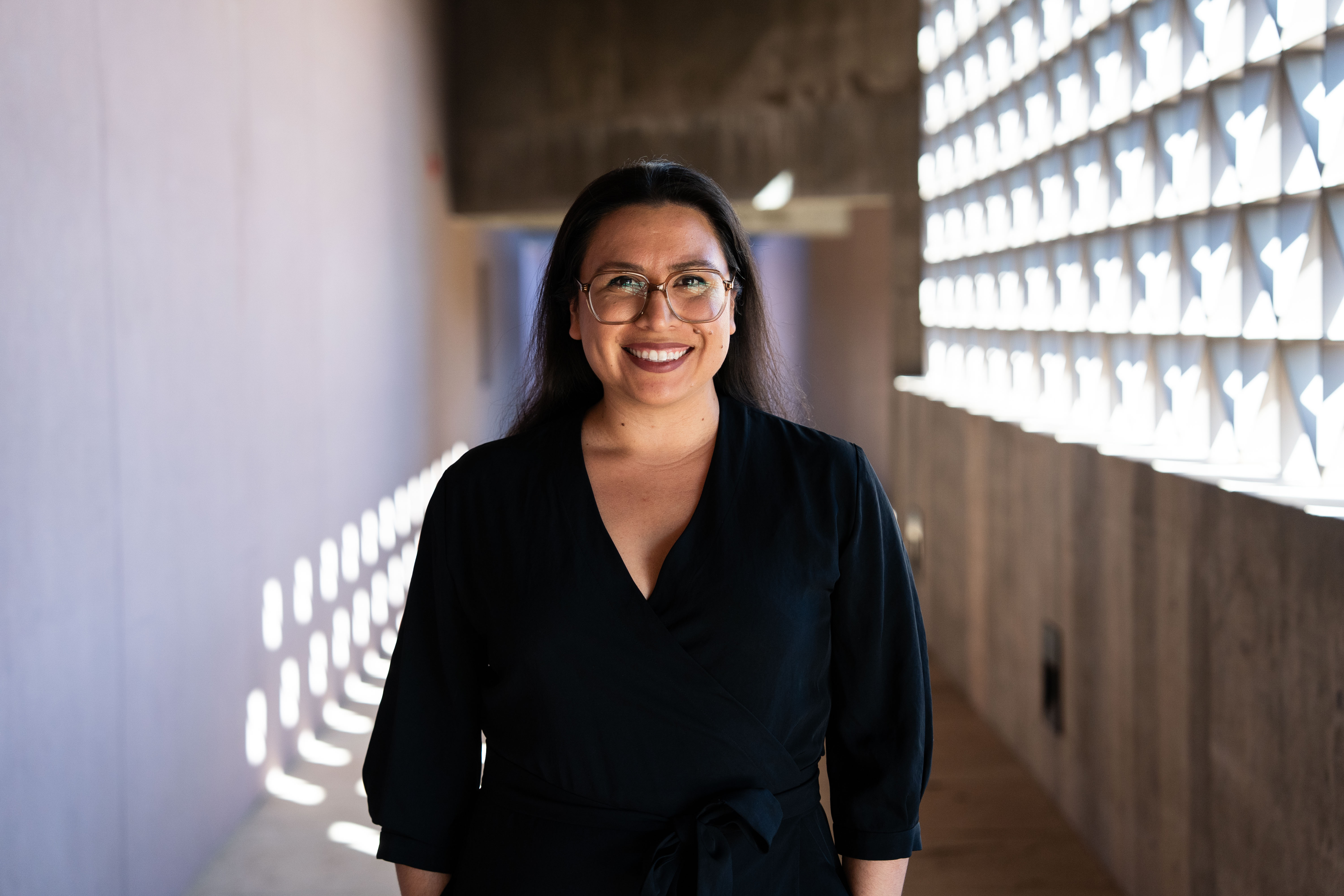
Alana Hernandez is Senior Curator at the ASU Art Museum, where she leads the curatorial team and oversees the exhibition program. In her curatorial practice, Hernandez co-creates and develops relational projects and exhibitions that amplify intersectional and multifaceted interpretations of Latinx art. Most recently she curated and opened a new exhibit Carmen Lomas Garza: Picturing the Familiar. This the first major exhibition devoted to artist, activist and educator Carmen Lomas Garza (b. 1948) since 2001, the exhibition offers fresh insight to her expansive career and follows Garza’s work across media. The show situates her practice within a broader cultural landscape, featuring works by contemporaries who collaborated with or influenced her at pivotal moments. Previously, Hernandez served as Executive Director & Curator at CALA Alliance from 2021–2023. From 2019–2021, she was Assistant Curator at the Museum of Contemporary Art San Diego where she organized the museum's first collection handbook, Museum of Contemporary Art San Diego: Handbook of the Collection (2021). From 2017–2019, she worked at the Whitney Museum of American Art in New York, where she was part of the curatorial teams for the much-lauded exhibitions Vida Americana: Mexican Muralists Remake American Art, 1925–1945 and Pacha, Llaqta, Wasichay: Indigenous Space, Modern Architecture, New Art. |
We’d love to hear from you. Send your questions or reflections to ebasada@artistcommunities.org for a chance to be featured in an upcoming issue.