
Dear Network and Friends,
We’re still basking in Santa Fe’s wintry sun. In the afterglow of the conference, and in the busy weeks that followed, we’ve been continually reminded of the sense of community and collective care that shaped our time together at ACA’s 2025 Conference.
Across plenaries, conversations, and workshops, we were invited to think differently about memory, leadership, bravery, care, funding, and power — and about the particular responsibility artist residencies hold in this moment.
Below are a few highlights from the many thoughtful sessions and conversations that unfolded over the conference. Rather than a summary, this is an invitation to revisit the ideas that emerged, and to continue the work from where we left off.
In community,
The ACA Team
Shared Resources + Readings can be found in this folder [link]
If you participated in the conference and would like to offer feedback, please fill out this survey [link].
Conference Reflections + Voices
Future Memory: Creative Practices for Building the Legacies We Envision — This plenary asked how residencies might approach data, documentation, and archives not as administrative afterthoughts, but as ethical, creative practices that shape how artists are remembered.
- From Solana Chehtman:
“Archive work during studio work can be incredibly generative—it gives you a new outlook on your current process, and vice versa.”
“Archives can help artists realize that what they’re doing has value.”
- On oral history:
“A story about the past, told in the present, for the future.”
- On artist-led repositories:
“Let’s follow artists and what they want to record.”
- On the nature of archives:
“It’s less like an object and more like the weather.”
- The session also surfaced Indigenous histories of record-keeping — ledger art, beaded ration pouches — and the responsibility residencies carry when stewarding land, memory, and institutional power.
*
The Whole Picture: Bringing the Science of Data to the World of Art
— This session explored the promise, and the limits, of economic impact data as an advocacy tool.
- On data and value:
“Arts and artists are always facing the question of value.”
- On purpose:
“Data is in service to the local community.”
- On economic impact studies:
“What do we know? What can we prove? How can we leverage that?”
- Speakers outlined how direct, indirect, and induced effects can tell part of the story, while emphasizing that numbers alone cannot capture cultural life, especially for smaller organizations or non-monetized practices.
- Participants were encouraged to pair quantitative data with community-based narratives, equity indicators, and local partnerships.
*
From Safe Spaces to Brave Spaces: Reimagining Artist Residencies for Collective Transformation — This session questioned the limits of “safe space” language and asked what it means to build environments rooted in trust, risk, and truth-telling.
- From Mayumi Hamanaka:
“Brave space is not only having a supportive environment, but having the trust to take risks.”
- From Christine Wong Yap:
“Fear, anxiety, exhaustion, and depression—none of these spaces feel safe.”
“Value progress not perfection; feedback is a gift.”
- On practice:
“Brave space takes us beyond safe, where opinions can conflict, where the artists can come and challenge the institution and the institution can hold that.”
- On power:
“Safe vs. brave is intrinsically about power—what are people concerned will happen if they speak?”
*
Meeting the Moment: Residencies as Leadership Incubators — This plenary positioned artists as essential leaders in a moment when traditional leadership models are failing.
- From Sanjit Sethi:
“Residencies are rare spaces where failure isn’t seen as catastrophic—it’s seen as generative.”
“Empathy without vulnerability is just saviorism.”
“The question is: do we have the courage, commitment, and tenacity to create the conditions for artists to lead?”
- From Chrissie Orr:
“What if collaboration—and all its messy complexity—was how we interacted day to day?”
“Be a mischief maker.”
- From Roger Montoya:
“The people you need most are right in front of you.”
- From Joseph Kunkel:
“Design is never neutral. It either hurts or heals.”
- Leadership, speakers emphasized, is rooted in listening, responsibility, and the willingness to compost what is broken into something new.
*
The Art of the Residency: Finding Your Place to Grow — This session explored how artists choose residencies and how organizations can be more transparent, responsive, and humane.
- From Lily Cox-Richard:
“Never underestimate the time that you have nothing to show for.”
- On feedback and care:
“Exit interviews matter.”
“Create vehicles for honest feedback that aren’t promotional.”
“It is important to tell artists, ‘we are working on this — here is what we’re doing.’”
- From Edie Tsong:
“Residencies are a great validation of the work nobody asked us to do.”
“One of the best things is being fed.”
“Part of the life of an artist is finding support in the community.”
- From Eugene Gloria:
“You think you’re going to a residency to be inspired—but you’re really going to change.”
“Limitations are where the real work takes off.”
*
Artist Residency Wellness: Caring for Artists and Staff — This session centered wellness as relational, collective, and inseparable from sustainability.
- On wellbeing:
“Wellbeing is woven into community stability.”
“How can we position ourselves toward wellness, not just productivity?”
- On permission and care:
“Giving people permission to say no.”
“Being both artists and administrators is its own tension.”
- Participants mapped “webs of support” and “webs of worry,” naming shared anxieties and collective solutions.
- Laughter, tears, and vulnerability underscored the need for solidarity — for artists and the staff who care for them.
*
Aligning the Constellation: Co-Creating Sustainable Funding Models — This session reframed philanthropy as a shared ecosystem rather than a hierarchy.
- From Meg Leary:
“Dissipating power dynamics starts when you understand the funding landscape.”
“Think of yourself as an advocate—engaging local politicians and policy makers matters.”
- From Lara Evans:
“Money isn’t always the primary relationship.”
“We have traditions of making to exchange, to build relationships, to sustain culture.”
- From Kimberleigh Costanzo:
“Position yourself as a learning organization—what should we read, watch, listen to in order to understand an artist’s work?”
- Speakers emphasized transparency, long-term thinking, local advocacy, and funding models that support ecosystems.
*
Organizations as Organizers: Transforming the Public Sphere — The closing plenary asked how organizations might move from advocacy to organizing—toward power, belonging, and civic imagination.
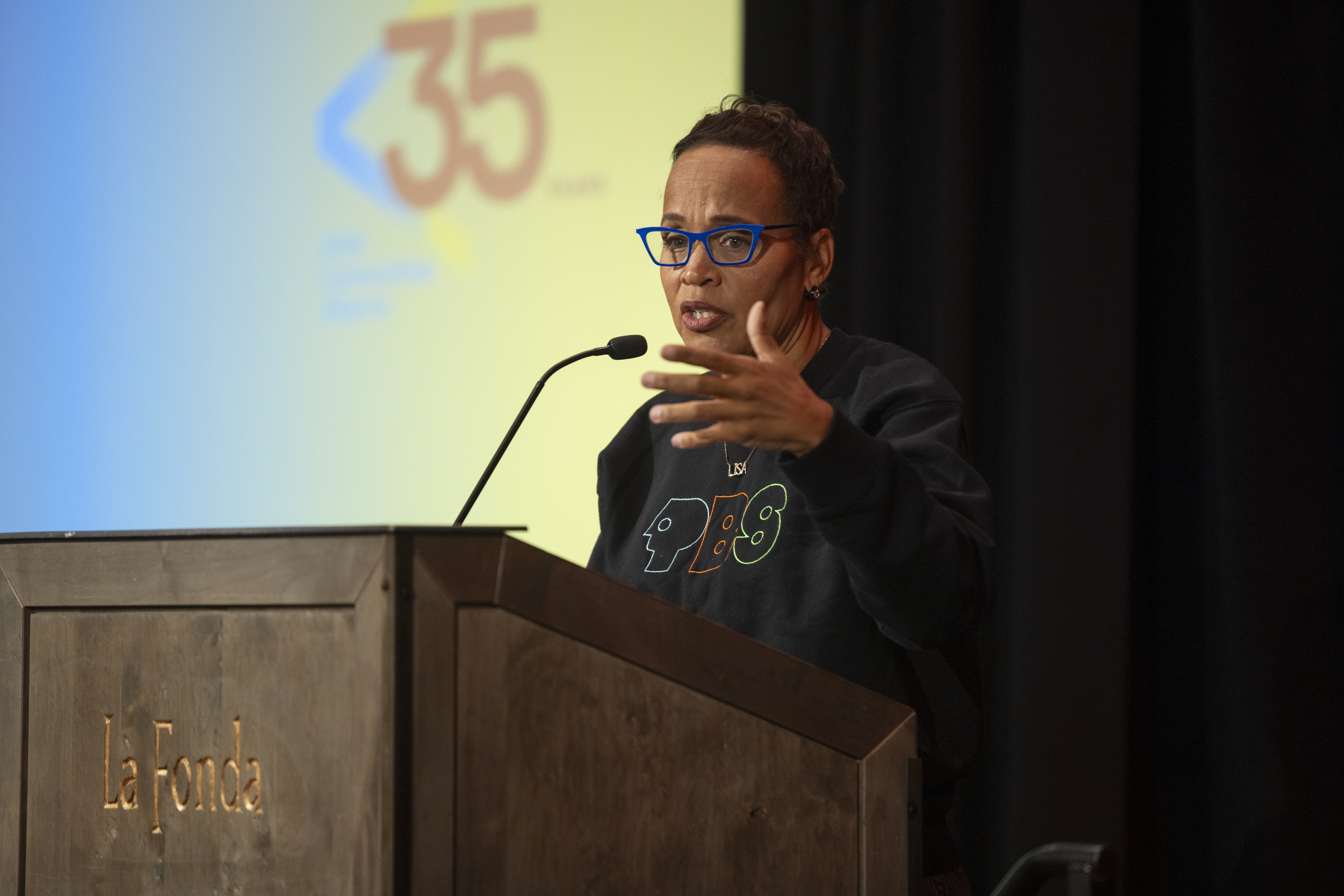
- From Lisa Funderburke:
“Organizing is leadership that enables people to turn the resources they have into the power they need to make the change they want.”
“Our ability to convene people in physical space is our superpower.”
“How do we bridge across meaningful differences? How do we not reinforce the separation and othering we experience daily?”
- From Roberto Bedoya:
“I’m a form of AI: Ancestor Intelligence”
“The power of making your story and argument are necessary to feed a new imagination of democracy so we can have our emancipations and liberations and are not being belittled".”
“I’m thinking about the civic ‘we’—the people we don’t know.”
“Culture is fluid. Policy tries to fix rules around it.”
- From Eleanor Savage:
“When people feel love, they feel power.”
“Who owns spaces that free in this country? How can you make space in a different way for the artists in this time?”
- From Asa Jackson:
“The more responsibility you take, the more empowered you become.”
“I can’t look up or down at anyone to be in relationship.”
- Across the panel, speakers returned to accountability, risk, and the question: What are the practices that don’t yet exist, but need to be imagined?
Thank you to our community who came to participate in last year's conference! We look forward to continuing the conversation with you.
ABOUT ARTIST COMMUNITIES ALLIANCE:
ACA is the international service organization for artist residency programs and artist-centered organizations. ACA's mission is to advocate for and support artist residency programs as a means of advancing the endeavors of all artists. We currently support a global network of members and work on behalf of 1,500 residency programs worldwide. Since 2004, ACA has provided more than $4 million in direct grant funding to artists and artist residency centers. More information about ACA can be found [here].